Friday, February 10, 2012

Now What...? I already have a pipe....


Ok…., lets be specific

A smoking pipe that is specifically made to smoke tobacco typically consists of a chamber (the bowl) for the combustion of material followed by a short tube (the shank), ending in a mouthpiece (the bit). Pipes can range from the very simple machine-made briar pipe to highly prized handmade and artful implements created by renowned pipemakers, which are often very expensive collector's items. "Estate pipes" are previously owned pipes that are sold to new owners.

For those who are new to the hobby the idea is rather strange… But once the new piper starts to rub elbows with more practice pipe smokers, he or she will notice that many times that’s the way to go. Why? Because it’s also a collectors hobby… Pipe smokers swap stories they swap, trade, sell and some times barter services for a pipe.

And what would a seasoned pipe smoker be looking for in an “Estate Pipe”?

First of all if it has been thoroughly reamed, cleaned, sweetened and polished. Swapping or buying an estate pipe that looks like what ever is in residence in there could kill your pet hamster is not a great idea.

Even though clean, as a used pipe it still should have a “dime’s” thick wall of carbon. Which was created by all the tobacco it smoked.

Second, the obvious, what was smoked in there? No… not the wacky weed! What type of tobacco? English? Aromatic? And so on. If you are a staunch defender of the Aromatic tobacco you should buy a pipe that smoked Aromatic tobaccos… If you smoke English, or you wish to get an estate pipe to smoke English, your new/old pipe should have smoked English tobaccos. Think about it… If you smoke Aromatics in a pipe that puffed on English tobaccos, like: Latakia, Perique, etc, it is going to taste awful and the aroma is going to be something out of a grisly novel! That is why the smart pipe smoker has several pipes. Pipes for the Aromatic tobaccos, for the English and the non-Aromatics ( many times they have no casing, aromas, and the blend is mostly burleys).

Make sure it has a new bit, also called a stem. New bits are changed by the hand full; the best pipes will have rubber, also known as Vulcanite or something fancy like acrylic. Dunhill pipes for example, only uses Vulcanite (because of the use of their branding mark, the white dot). You don’t really want a bit with someone else’s teeth marks on it…Yuck… lol (laughing out loud) just making sure.

And lastly, who made it, what company…, pipe maker…., is it of briar or a different wood? And when was it made? You could have found a treasure!

Below is a short description of what you can expect to find as pipes and their stems: (Pulled from Wikipedia)

The bowls of tobacco pipes are commonly made of briar, meershaum, corncob or clay. Less common are cherry wood, olive wood, maple, mesquite, oak, and bogwood. Generally a dense-grained wood is ideal. Minerals such as catlinite and soapstone have also been used. Pipe bowls of all these materials are sometimes carved with a great deal of artistry.

Unusual, but still noteworthy pipe bowl materials include gourds, as in the famous Calabash pipe (lined with Meershaum), and pyrolytic graphite. Metal and glass are uncommon materials for tobacco pipes, but are common for pipes intended for other substances, such as… Naah…

The stem needs a long channel of constant position and diameter running through it, although filter pipes have varying diameters and can be successfully smoked even without filters or adapters. Because it is molded rather than carved, clay may make up the entire pipe or just the bowl, but most other materials have stems made separately and detachable. Stems and bits of tobacco pipes are usually made of moldable materials like vulcanite, Lucite, Bakelite, and soft plastic. Less common are stems made of reeds, bamboo, or hollowed out pieces of wood. Expensive pipes once had stems made of amber, though this is rare now.

So where do you go for used pipes? For starters, Benningtons, we buy and trade old pipes. As well as, new of course. If you find a pipe that you really like, we can look at it for you and tell you if there is anything that needs done to get it ship shape. Many times there are great finds out there. And if you have old pipes you don’t care for anymore we can take a look and see if we can do business….

Friday, February 3, 2012

Should The FDA Regulate Cigars


If the FDA controls premium cigars, the cigar

business will be quite different.


Did you kow that...

On April 26, 2010 the U.S. Food & Drug Administration (FDA) publicly announced its intent to regulate cigars through regulations that had previously applied only to cigarettes. The June 2009 the signing of the Family Smoking Prevention and Tobacco Control Act granted the FDA unpredictable power to impose strict new controls on the making and marketing of tobacco products but did not initially appear to apply to cigars or pipe tobacco, only to cigarettes.


Well, in April of 2010 and again in December of 2010 and July of 2011, the FDA made it clear with detailed postings in the Federal Registrar that its intent is to apply the same standards for nicotine content, advertising materials and marketing to cigars. The FDA had begun work on rules to eliminate full color advertising, all forms of outdoor advertising and point of sale advertising in tobacco shops while requiring the prominent posting of graphic anti-smoking literature and posters within tobacco retail shops.


But The International Premium Cigar and Pipe Retailers Association, an industry trade organization and The Cigar Rights of America, a consumer grass roots organization, reacted by achieving the introduction of House bill H.R. 1639, titled the Traditional Cigar Manufacturing and Small Business Jobs Preservation Act. This important legislation aims “to exempt traditional large and premium cigars from regulation by the Food and Drug Administration (FDA) and from user fees assessed on tobacco products by the FDA.” Initially sponsored by Representative Bill Posey from Florida,

The bill has gained the support of 68 Representatives from 22 states since its introduction in April 15, 2011. On August 1, 2011, a companion bill under the same name was introduced in the Senate by Senator Bill Nelson of Florida. The Senate Bill (S. 1461) has gained the sponsorship of two additional Senators since its introduction.


So, the FDA, today, has to apply to take control of cigars and pipe tobacco and has not succeeded. Try as they might something always gets in the way...lol


Have agreat weekend...... Long ashes,

Jim & The European Cigar Journal

Friday, January 27, 2012

What of The Binder??


Inner Value Rather than Beauty

The wrapper has been considered the crowning dress of any cigar. Always costing more than any other tobacco. It’s the tobacco that is visible, caressed, sniffed and delicately squeezed like a prized tomato… But it is underneath the pretty dress that the Master Benders know that the real gold is found. Often rough looking, with a hearty aroma, sometimes sweet or peppery. Called Capote in Spanish, it is crucial to the overall composition of great cigars.

The binder helps with the burn and helps give our cigars complexity and aroma. At the Perdomo Factory the binder is planted, harvested, dried and fermented exactly like their sun grown wrappers. Which one they chose, will depend on the planned blend and, above all, the matching wrapper. “It is part of the blend, and gives the cigar significant accents….” Said Nick Perdomo.

Bruce Lewis; VP of sales and marketing for the ToraƱo Family Cigar Company has extensive knowledge of everything to do with raw tobacco: “The binder is probably the part of a premium cigar that is most overlooked and underestimated. It needs to be physically strong and elastic enough to keep the form of the filler leaves. Just as important is that it produces a good burn so that the cigar has a regular and sufficient glow. When the binder doesn’t burn well, the risk of an uneven burn increases dramatically”. Said Bruce…

Tobacco engineer Hendrik Kelner observed: “ We use Dominican binders of the types Olor, Piloto, San Vicente and some hybrids wich we cultivate. We also import binders from Peru, Ecuador and the broadleaf from the US. All with various stimulations when it comes to taste and aroma. The binder dictates the ring gauge, the strength and the aroma.

Rocky Patel adds saying…”When we want to roll a full-flavored cigar we’ll take a binder from a higher priming (ligero). On the other hand, with a milder one, we take a binder from a lower priming (seco) of the tobacco plant.

Burning Properties

Edmundo Garcia of General Cigar: “The function of the binder is to help the wrapper to burn evenly and regularly – also with the desired color of ash”

And even though we don’t see the binder, it I no advisable to use tobacco with protruding veins, its important that they be even colored. This characteristic will produce an even smoke.

Binders should ideally burn white so that they balance out the inadequate burn of some wrappers. I remember seeing a cigar maker choosing among different binders being offered: He would smooth the dried leaf, then light a point in the middle of the leaf and observe its smoking ability of the leaf: “Fireproof tobaccos are less desirable”

There are so many variations, on so many levels, that the ultimate determining factor is harmony.

Enjoy….. And until next time.

Christina

Friday, January 20, 2012

A Pipe Club Meeting

Robbie Cippolla


We have a pipe club called the Boca Raton Pipe Guild. The club members meet every two months, always on a Thursday, at the Moose Lodge in Deerfield Beach, on the north west corner.

Its a lot of fun. This past meeting, yesterday actually, was a pipe swap, show and tell.

Robbie Cipolla, made a fascinating presentation regarding pipe care. From the basic everyday care to the more deep reeming and cleaning.

A-mazing!


Larry Lampner


Larry Lampner, our President, made a video of it. We will make it available on our channel on Youtube.

We are very fortunate. We usually have a great guest, like Mimo, Erik Stikkebye (we had his father over many times; Peter Stokkebye), Castello or Ashton Pipes. Last year we had Frank Blews from Philips and King, what a treat!


We also have a smoking contest every March. So it’s a month and a half away. We compete officialy, sanctioned by the UPCA, the United Pipe Clubs Of America. We even give out a trophy to the first place. Every one ends up getting something. Going home with an extra pipe and some tobacco if you are lower in the totem pole.... lol


The other meetings we have guests,. Last year we had Peder Jeppesen from Neerup Pipes. He was so well received that we are hoping to get him to return this May.


The meetings after that will have other pipe makers or pipe tobacco masters. By the end of the year, in December, we organize a fun holiday gathering. Last year, 2011, we met at the Moose Lodge.


You must be wondering why the Moose Lodge? Its the only place that enables us to meet and smoke, as we taste different tobaccos.

We become members with a yearly onetime fee of $60.00 and $15.00 to the Club. It’s great! It gives us a place to meet, an actual dinner, and we can smoke to our hearts content! The only thing that’s out of pocket is the couple ($3.00 each) of beers or soda pop we buy that evening


Peder Jeppersen with Pipe Club Member, James


The video will be ready next week and we will be able to share it with all our friends.


Have a great weekend all... Untill next week.

Long ashes....


Jim

Friday, January 13, 2012

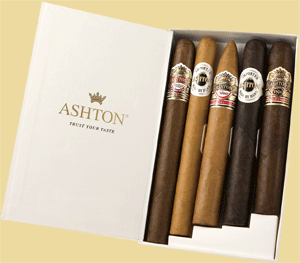
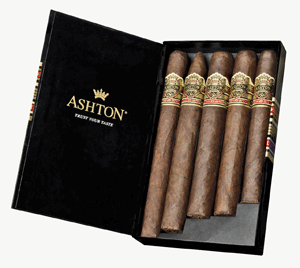
Ashton Story Part II

The Next Generation

Colin unveils the secret behind the success of the Ashton brand as being the core team of Rob Levin, Many Ferrero and now Meera and Sathya Levin, Rob’s two children, whom as they finished the university they joined the company. Meera as International Sales and Marketing and Sathya taking over daily operations. Rob mentions that the 3 most important moments in the company’s history were: the start of the Fuente relationship, Meera and Sythia’s joining the company and the start of the relationship with the Garcia family.

Rob noted the three most important moments in the company’s history: The start of the Fuente relationship, Sathya’s and Meera’s joining the family company and the start of the relationship with the Garcia family, with whom the Sathya was instrumental in starting.

Central America

Rob had developed a line called “La Aroma de Cuba” to be sold in the US only. Made in Honduras, it was an inexpensive cigar if compared to the rest of the Ashton portfolio. It had the distinct taste of Central America. So when Sathya brought him a cigar to taste, both Rob & Manny were both impressed. The cigar was made by Pepin Garcia, a fast rising star in the world of cigars. As Pepin met with the Levin family and Manny Ferrero, the bond was instant… Manny recounts. This new relationship resulted in the new cigar line, San Cristobal, which outside of the US is called Paradiso, to be included to the already exquisite Ashton portfolio.

La Aroma de Cuba, called La Aroma del Caribe outside the US, won the 2011 Cigar Journal Trophy for the best Nicaraguan blend.

When asked what was their philosophy in running a cigar company, the Levins replied:

Taste, consistency and quality. Ashton’s “Taste of Excellence” event, held at retailers, around the world have a consistent theme. They want you to taste the cigars fully, no matter what you are smoking. It is only then that we will truly appreciate any cigar, that we will be able to appreciate Ashton to it’s fullest.

Wednesday, December 28, 2011

Ashton Story Part I


The new Cigar journal is a great publication! It used to be named the European Cigar Cult Journal. As the owners and publishers changed, they wisely changed, or better yet, they updated the original name to “Cigar Journal” and distributor l”. It’s the best cigar magazine today! I can say that, because I was its American editor for over 5 years in the mid 90’s. Apart from Reinhold, Cigar Journal has a new writer, Colin C. Ganley who shared with us Ashton’s story.

Ashton cigar is owned by the Levin family, also owners of the smoke shop Holts. This was very interesting, because most of the information I had in my head was separate. Ashton was a separate entity from Holtz.

The article was able to bring it all together and create one picture.

As per the article, the relationship of the Fuentes and the Levin’s developed before 1985, when the first blend of the Ashton line was created. By 1985 it was considered a medium bodied smoke. Today we refer to it as a mild smoke…..lol Not that the blend was changed…

A note: Americans developed a taste for stronger blends than Europeans or South Americans, who prefer lighter and shorter smokes.

Four or five years later, 1990, the American market had matured enough to be introduced to a more flavorful blend.

This is when the cabinet series came out, followed by the Maduro line. As we roll into the mid nineties, the cigar boom explodes the market and the new American cigar smoker wanted an even stronger blend. It was the perfect timing to launch the Virgin Sun Grown, today known as the VSG.

End of Part I

Long ashes.....

Jim

Wednesday, December 14, 2011

What will you chose this Holiday?


What you eat will dictate what you smoke or vice versa. If you leave the house carrying a certain blend of cigar(s), what you have in your pocket will call for a specific menu.

A repast of fish and vegetables will call for a light dry wine and a mild smoke. A Don Diego, a Romeo Y Julieta, a Davidoff 1000 (thousand) series or a Dunhill.

Stepping up to fowl of any sort will work well with a light red wine and a cigar with a fuller body. A Montecristo White, a Miami made Cuervo Rojo from our humidor in Boca Raton, FL.

And if you are served a steak, enjoying an aged scotch, you should enjoy a full bodied blend. A Montecristo Classic, a Partagas or Cohiba. Or a Kuba-Kuba from Drew Estates.

Any of the above choices will fit the three basic menus above, with personal variations. So what to do after the holiday meals? Usually the best idea would be to bring a medium smoke if you can smoke at the dinner party. With an aroma that would be pleasurable for the guests to experience.
The best way to enjoy a good smoke here in Florida is to smoke outside. Drawing a fire pit to chase away the cold, having mulled wines and ciders. Hot buttered Rum or spiced Eggnog.
Enjoy!

Jim